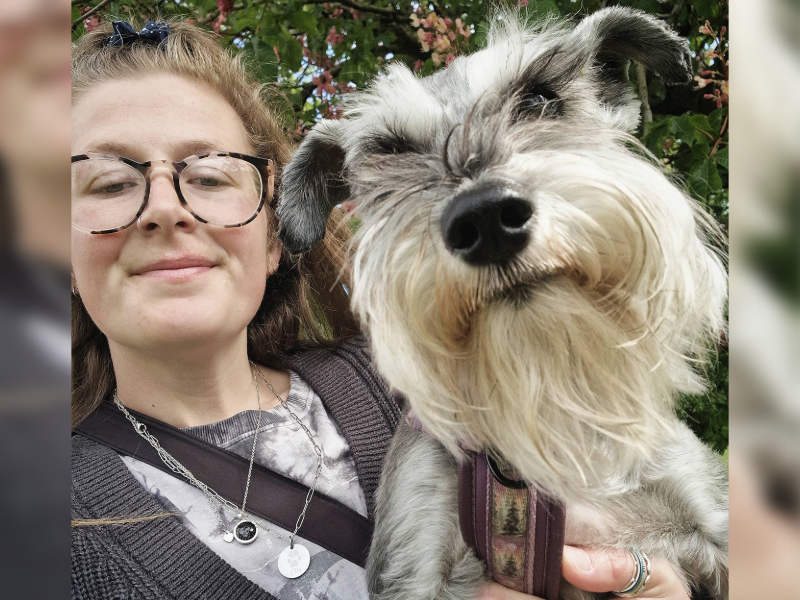
Emily has been receiving support at Cygnet Alders for 16 months and she has introduced the coffee morning initiative as part of her ongoing recovery. Alongside this, she is also continuing to train her assistance dog, Ella, who plays a central role in her day-to-day wellbeing.
Emily explained that she was admitted to the Podsmead Road hospital following a period where she “couldn’t click with life anymore.” Since arriving at the service, she says the support from staff has been instrumental in her progress.
“The staff are all amazing, they’re really helpful. I can’t fault them,” she said. “This place has got me back on my feet.”
Emily has been supported by occupational therapy assistant Chloe Button to create her Friday coffee mornings as part of her recovery programme. ‘Pups and Cups’ was a goal that Emily has created within her occupational therapy work.
Originally starting on her ward, the coffee morning has since flourished and expanded to the social hub, accessed by all patients. Together with Chloe, Emily has created menus and produced branded clothing including aprons and t-shirts to wear during coffee mornings. Prizes have also been created for patients and staff to win during coffee morning.
The idea for the coffee morning came after Emily began using a coffee machine gifted by her mother.
“I started making coffees for staff and patients,” she said. “If I was making one, I’d ask, ‘does anyone else want one?’ Then we came up with the idea of doing a coffee morning as a Friday treat.”
The weekly event is now held in the service’s social hub and has grown into a well-attended and anticipated part of the week.
“We’ve made a whole menu,” Emily explained. “We do cappuccinos, lattes, hot chocolates, things like Biscoff and Nutella flavours as well. We also have pastries or baked goods.”
Reflecting on the impact of the coffee morning on her own recovery, Emily said: “It really helps my confidence. I’m not a very confident person, but knowing that I have something people rely on, people saying they’re looking forward to it, that really boosts my confidence.”
The coffee morning provides an informal environment for both patients and staff to spend time together outside of structured sessions.
Emily said: “I’m naturally really shy so it would be easy for me to spend most of my time in my room. I don’t usually go into the lounge or socialise because it stresses me out. So having the coffee morning helps me get out and do something.”
Staff have also observed the wider benefits of the initiative. Jess Warburton, Activities Coordinator at Cygnet Alders, said: “It gives patients the opportunity to build relationships with others and with staff in a more relaxed setting.
“It’s not a formal therapy session, it’s something people choose to attend and enjoy. The sessions have also supported confidence in engaging with other activities, it can make it easier for patients to attend groups.
“They come to the coffee morning, get to know people, and that can reduce some of the anxiety around other sessions.”
Emily has also used the coffee morning to support fundraising efforts, organising an event that raised £250 for Mind.
“I made brownies, shortbread and cheese twists,” she said. “Patients, staff and visitors all donated.”
A key part of Emily’s progress at Cygnet Alders has been her assistance dog, Ella, a miniature schnauzer who lives with her at the service.
Ella is trained to support Emily in a number of ways, including monitoring her physical and emotional state.
“She alerts me if my heart rate goes over 100,” Emily explained. “She’ll nudge my leg or nibble it to let me know I need to sit down and calm down.
“Ella is also trained in grounding techniques. I’ll sit on the floor and she’ll lie across my legs. That pressure helps to ground me.”
In addition, Ella can alert staff if Emily requires support.
“If I’m in my room and not safe, she’ll bark to alert staff. She doesn’t bark for no reason it’s part of her job.”
Ella also responds to behavioural cues, such as leg shaking or signs of dissociation, helping Emily to regulate and refocus.
Staff at the service have also recognised the impact Ella has had.
Jess Warburton, Therapy Coordinator, said: “The skills that Emily has trained Ella to do are incredible. She’s highly attuned and provides consistent support, not just to Emily but also within the wider environment.”
Emily has continued Ella’s training during her time at Cygnet Alders, supported by the team. Ella is now approaching her final assessment to become a fully qualified assistance dog.
“She’s already completed several assessments,” Emily said. “The final one is the graduation assessment, where she has to demonstrate everything she’s learned in one session.
“The assessment includes maintaining focus in distracting environments and performing a range of support tasks.
“It’s not easy to train an assistance dog. There’s a lot that goes into it, but it’s very rewarding.”
Emily described Ella as a key source of motivation in her recovery.
“She’s my whole world,” she said. “If I’m struggling, I think about her. If I act on certain urges, I won’t be able to take her out myself, and I want to be the one who looks after her.”
Looking ahead, Emily hopes to continue her progress and eventually be discharged.
“I want this to be my last admission,” she said. “I want to move forward and not come back into hospital.
“For now, my coffee mornings and focus with Ella are really helping with my recovery and I’m looking forward to seeing what I can achieve next.”