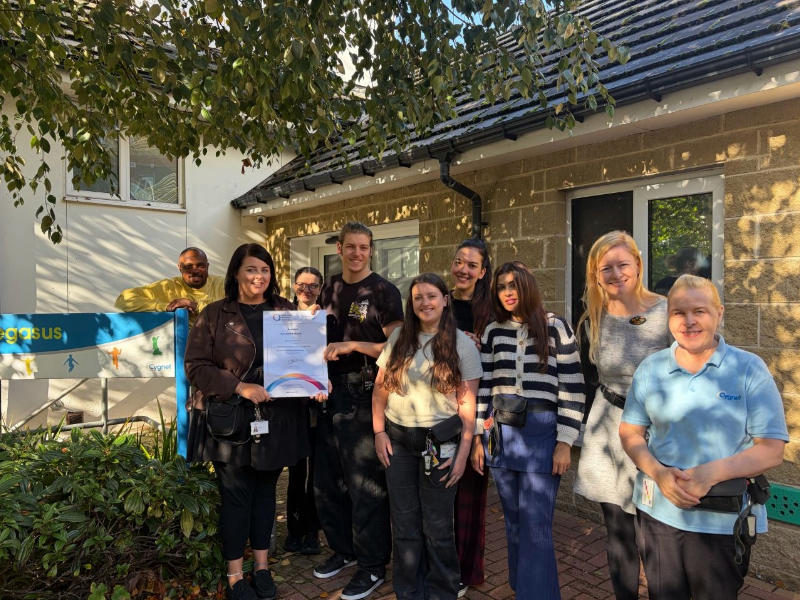
The 13-bed ward, which supports young people struggling with their mental health, was awarded Accredited Autism status following a detailed assessment of its autism practice, including communication, independence and self-reliance, sensory experiences and emotional wellbeing.
The National Autistic Society’s Autism Accreditation programme sets standards for autism practice and provides a framework to help services develop supportive environments and cultures which lead to positive outcomes and quality of life for autistic people.
Assessors praised a number of areas of practice at the East Bank Road hospital, particularly the team’s personalised approach to communication and involvement of young people in decisions about their care.
The report read: “Communication support is highly personalised, with a range of strategies and tools to promote understanding, participation and self-expression. Autistic young people and their families are actively involved in assessment, care planning, and decision-making, with appropriate adjustments made to maximise participation.”
During observations on the ward, assessors saw how staff adapted the way they communicated according to the needs of each young person.
Assessors said: “Across all observations, staff supported each autistic person by simplifying and adapting their spoken language to promote understanding. A good level of consistency was evident, with staff modifying their verbal communication in line with individual needs and using familiar, consistent phrases, particularly when giving instructions, to support understanding of expectations and what was happening now and next.
“Communication is tailored to the individual rather than being determined solely by diagnosis.”
The assessment also highlighted the relationships between staff and young people, and the importance placed on giving young people meaningful choices and opportunities to express their views.
The report said: “Relationships between staff and individuals were consistently positive and trusting, and it was clear that support was highly personalised and person-centred. Staff demonstrated an understanding of each individual’s communication strengths, preferences, and needs, adapting their approach accordingly to support understanding and engagement.”
Assessors also praised the way Pegasus Ward supports young people to build independence and practical life skills.
Personalised visual timetables are used alongside visual prompts and predictable routines to help young people understand and prepare for their day. Easy-read, step-by-step guides are also available for everyday tasks including personal care and laundry.
The report read: “Staff provide the right level of support to enable each autistic person to experience a sense of completion and success whilst helping them develop skills of self-reliance and resilience.
“Each autistic person is supported to actively express preferences, make choices, and take decisions.”
Sensory support was another area highlighted by the assessors, who described it as a well-developed part of the support provided on Pegasus Ward.
Young people complete sensory preference checklists as part of their initial assessment, with further assessments carried out where additional needs are identified. Sensory information is then used to develop personalised support plans and strategies.
Assessors observed a range of sensory spaces and resources available to young people, including a sensory room, a quiet room with adjustable lighting, art facilities and outdoor spaces.
The assessors were positive about the approach to emotional wellbeing on the ward.
The report read: “Autistic individuals appeared to feel safe, calm, and at ease. Staff demonstrated an understanding of each individual’s support needs and consistently used proactive and preventative strategies to reduce the likelihood of anxiety, confusion, or distress.”
“Autistic people are treated with dignity, status, and respect and are provided with meaningful positive feedback to boost confidence, self-esteem, and self-worth.”
Young people have also played an important role in developing support on the ward.
One initiative highlighted by assessors was Pegasus Ward’s Welcome Pack, which was co-produced with a young person in response to feedback about the experience of being admitted to hospital. The personalised packs can include visual timetables, easy-read information, activities, coping strategy cards and sensory items.
Assessors said: “Young people found the packs helpful in reducing anxiety and increasing understanding of what to expect during admission. A key learning from the project was the importance of offering choice rather than making assumptions about autistic young people’s needs, recognising that support should be individually tailored.
“Young people are given opportunities to influence decisions and suggest changes to ward practices.”
Assessors also spoke directly with young people and families as part of their visit. One parent told assessors: “I feel my child is very supported at Cygnet. They check in with parents everyday and any worries I have are taken on board.”
Ward Manager Stacey Burgess said: “Achieving Autism Accreditation is a fantastic recognition of the commitment of the whole Pegasus Ward team and the personalised support they provide to our young people every day.
“We are particularly proud that the assessors recognised the way colleagues listen to young people and involve them in their care, as well as the strength of our approach to communication, sensory support, independence and emotional wellbeing.
“The fact that young people themselves have helped us develop initiatives such as our Welcome Pack makes this achievement even more meaningful. Their voices, and those of their families, are incredibly important in helping us continually improve the support we provide.
“We are very proud to receive this accreditation and will use the assessors’ feedback to keep developing our practice and working towards even higher standards of autism support.”