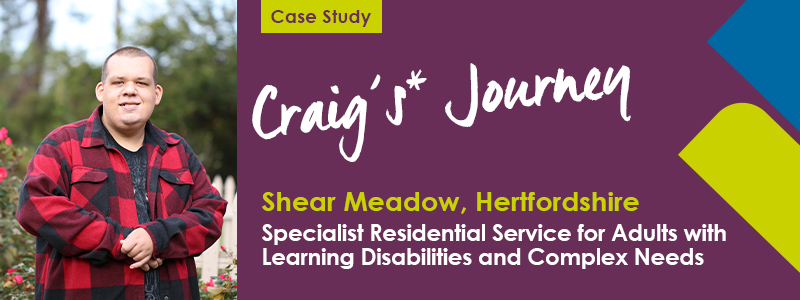
Craig’s* history
Craig is 27 years old and lives with Autism, Down syndrome, and severe sensory processing needs. He also has visual and auditory conditions, was diagnosed as obese, and is non-verbal in his communication.
Before moving into the service in 2022, Craig had been residing with his parents. During the COVID-19 pandemic, he spent approximately two years alone with them, having minimal contact with the wider community. Consequently, Craig became very isolated and struggled to cope with any sensory stimulus or new people.
His placement at home was at high risk of breakdown as the family struggled to manage his extremely challenging behaviours, which were often manifested physically due to his high levels of sensory distress. Craig spent his days in a dark room on his iPad or listening to music, often eating unhealthy foods. On one occasion, his family managed to support him into the community to a park; however, safety measures, including the use of adapted equipment for mobility and security, were necessary due to a history of absconding from excursions, home, and previous placements.
When Craig Came to Us
Due to Craig’s complex needs, particularly his sensory and anxiety profile, it was determined that a highly structured, intensive, and long transition plan was essential to minimise trauma and facilitate a successful move. He transitioned to Shear Meadow over the course of several months, initially with one staff member visiting the family home in Oxford three times a week, extending to different key staff for the final weeks. Some days, Craig would allow staff to sit in the room; other times, he would walk them straight back to the door.
When Craig eventually moved into Shear Meadow, he had a very challenging time adapting. He caused significant environmental damage to the service, ripping all boards and posters down to keep the environment empty. He would sit in a dark room for long periods, refusing to engage with staff or activities, finding it very challenging to be around the different noises and stimuli of sharing a home with other people.
During the first year, there were concerns about whether the placement was sustainable. This followed 12 safeguarding referrals made within the first six months due to incidents with other individuals living at the service and several serious physical incidents directed towards staff. However, the team continued to support him, learning and adapting their ways of working with Craig.
Craig’s Care
To support Craig, the team cleared the walls and the communal lounge of decorations and purchased a small projector light to start introducing some sensory stimulus and to expand his tolerance levels. Although he initially enjoyed looking at the patterns, he would break them when in a heightened state.
A major step in his care involved a medication review. Due to isolation and poor health management previously, Craig had been on medication for over 10 years, which was intended for short-term use. The team worked to rectify this, slowly adjusting his diet and completing various referrals.
The team began desensitisation work, gradually adapting the environment by adding a single empty photo frame on the wall and involving him more with other residents in a controlled 2:1 environment. They also began short walks in isolated environments, such as large country fields. Over the course of six months, they added two more empty frames, and over the next three months, photos were added a few at a time. Craig now fully accepts the frames and frequently looks through them with staff, using them as a communication tool to indicate activities he would like to do.
Over two years, his activities were also slowly increased. The team introduced more people and locations adaptively.
Craig Today
As a result of this consistent support paced to suit Craig’s needs, Craig has been able to explore his interests and passions without becoming overstimulated or entering a crisis. He has lost weight and is now out daily, actively participating in the community. He is a member of a church group, attends a weekly singing Makaton choir, goes horse riding and swimming weekly, visits the gym, and joins other individuals in the service for healthy cooking sessions.
Craig now attends parties and events at other services, fully able to cope with sensory stimuli and environmental challenges.
His progress reflects not only a reduction in challenging behaviour but a profound shift in his quality of life, self-regulation, and social inclusion.
Words from Craig’s Family
“Wow, it’s been 3 years now, and the changes I see in Craig are so striking. Even physically, he has lost weight, his skin is so clear, and he is involved in so many activities. All of this is so unheard of for us; the differences are unbelievable. He is so much calmer and a more manageable person; I think you’ve enabled him to gain so much self-control. We also see such an impact on his self-esteem and his overall happiness.
You’ve enabled him to take part in the things he loves so much and that matter to him. You can see the joy he has riding, singing, swimming and everything else. I’m so happy with all of it. Promoting health with the gym and long walks. The skills he has gained in cooking and shopping, we never thought he could do safely.
He is socially involved, with all his groups and the parties and mixing with people from other services and the community. It’s so amazing. I frequently share your photos and videos with our family, and Craig’s old staff, and they are all over the moon with his progress and with how you manage to support him to achieve all these things and his dreams, even going to the seaside in the sea. Craig loves the sea and had not been in it since he was a tiny child.
Thank you so much, Tony and all the staff at Shear Meadow.”
*Name changed to protect privacy