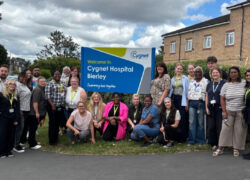
The team work collaboratively across all of the wards to support the psychological well-being of service users throughout all stages of their admission. They are fully integrated within all Multi-Disciplinary Teams on the ward and involved in daily reviews of decisions around care and treatment.
The team work in line with the Cygnet Health Model of Care for each service line. Initially, we want to support people to adapt to coming in to services which we recognise can be a particularly challenging time for anyone. The psychology team have an awareness of the wide range of factors that can affect an individual’s mental health and have led to their reasons for admission. We therefore offer a range of different assessments to get to know our service users better and to identify what support they might need. This could include assessments of well-being, trauma screenings, and to screen for the presence of different mental health conditions.
Members of the team are also trained to conduct assessments of Learning Disability and Autism Spectrum Disorder. We prioritise an individualised and person centred approach to everyone’s recovery journey, recognising everyone brings their own strengths and experiences that are important to consider during both psychological assessment and treatment.
The team regularly offer both group and individual therapies on the wards.
We put the service user at the centre of decision making throughout their recovery journey, and want to empower them to decide which therapy they feel will be most helpful for them. Different therapy options are available including Cognitive Behavioural Therapy, Dialectical Behaviour Therapy, Compassion Focused Therapy, and EMDR. These can support people with a range of difficulties including voice hearing, emotional dysregulation, substance misuse, interpersonal difficulties, low self esteem, and other offence specific work.
Groups may include relaxation and mindfulness, mental health awareness, coping with voices, and developing techniques to cope with trauma related symptoms as well as more general distress.
All wards also have psychology ‘drop in’ sessions at least once a week, so people have an extra chance to access support in between their regular therapy sessions, or as a one off when they feel like it.
The psychology team regularly signpost and support people to access relevant support networks and therapy options in the community, to promote awareness of resources available and increase continuity of care. As part of this, the psychology team implemented groups that mirrored the community based peer support groups ‘Andy’s Man Club’ and ‘Women’s Well-being’ to increase service users access to peer support groups whilst at Cygnet Hospital Bierley. Other examples of innovative care offered include the introduction of an EMDR Skills based group introduced in 2025.
Alongside this, the team help service users, and those involved in their care, to better understand any difficulties they might be experiencing and the support they might need. A trauma informed approach to care is adopted throughout an individual’s recovery journey, and psychological formulations form a part of this. We also use the principles of positive behaviour support across all of the wards to help individuals develop more helpful coping techniques for them. We really value the input of carers to provide essential insights in the individuals we are caring for, and try to promote ongoing support by involving them in information sharing for example with safety plans, positive behaviour support plans, and relapse prevention plans.
We value opportunities for empowerment and often look to co-deliver group and training sessions to promote the service users voice. We produce a monthly psychology newsletter which involves promoting principles around the Action for Happiness initiative, as well as a service user interviewing staff around this topic.
The team also help the staff to support individuals by offering them ongoing support. This includes weekly reflective practise sessions for each ward, ad hoc support, and regular staff training. Training sessions offered to promote the care staff offer to service users includes Learning Disability and Autism Awareness, Trauma Informed Care, Personality Disorder Awareness, DBT Skills, Professional Boundaries, and Personal Resilience.
The psychology team also value conducting research and promoting service development. Recent research conducted has included exploring factors that affect staff burn out levels within inpatient services, as well as exploring staff attitudes to personality disorder and therapeutic optimism for individuals with this diagnosis.