David’s History
David was born into a close-knit, Polish family. Developmental delays in early childhood led to a diagnosis of mild learning disability and special schooling from age 9. An assessment at 12 noted significant Autistic traits, with associated challenging behaviour at school that required further CAMHs intervention.
Despite the clinical challenges, David demonstrated notable achievements during his adolescence; he successfully completed a sports leadership program and achieved periods of supported independent living.
While these placements were intended to provide stability, they were often interrupted by periods of significant crisis. Recurring instances of distress and physical outbursts frequently necessitated emergency intervention, which unfortunately led to several placement breakdowns.
Through his early 20s, David received intermittent community support for emotional regulation and coping skills. His distress escalated, though, resulting in a series of admissions under the Mental Health Act.
Typically, on admission David was distressed and agitated, with presentations including self-harm and social disinhibition. Aggressive incidents, including verbal abuse and physical assaults on staff, often required the use of seclusion to ensure safety. With specialist support, he routinely settled and engaged well, but he often became overstimulated and deregulated by the high sensory and social demands of the ward.
Discharge back to supported living or family was the usual plan, but at 25, his parents could no longer cope, prompting another acute psychiatric admission. On discharge, David was trialled in a specialist ASD rehab placement where he soon needed intense additional care due to conflict with others. The intervention lacked therapeutic value, though and led to little progress.
When David came to us
Discharged from his third placement in quick succession, David arrived at Cygnet Lodge Lewisham in a state of acute crisis. The Pre-Admission Assessment noted that David was dishevelled and his thoughts were disorganised, leading him to digress significantly from the topic at hand, despite remaining articulate.
A significant advantage for the receiving team was the pre-existing therapeutic rapport between David and a senior staff member. The team leveraged this relationship and maintained a clinical conviction that David’s challenging incidents could be therapeutically resolved. Consequently, the team offered him a placement to stabilise the crisis in his care pathway.
Will Anderson-White, then Hospital Manager, recalls: “David was very sensitive to people he shares space with. He’s kindly by nature but doesn’t appreciate typical interpersonal boundaries and gets over-involved, coming across as extremely intrusive. He’d find it difficult to understand why people wouldn’t want to engage with him—of course these are service users suffering their own problems, often also struggling with communication and boundaries. The response from others in these circumstances, including staff, would often be to shut David down. Not being allowed the time to explain himself, David would get frustrated.”
David’s care
A new approach involving positive risk-taking was necessary, challenging the simplistic view that he required intense support in a secure setting to prevent violence. Reviewing his history, one thing stood out: his volatility, rapidly shifting from screaming and upset to playing and laughing. This instability distressed him. Seeing his dysregulation and frustration with his mood swings, a mood stabiliser was prescribed.
Hyperactivity and compulsion to be involved in everything were also noted. Without a formal ADHD diagnosis but based on a clinical impression including sleep trouble and irritability, a low daily dose of methylphenidate was prescribed. This led to an almost immediate reduction in his stimulation level.
De-escalating conflict now became easier by taking David aside to hear his perspective. Staff observations, discussed daily, were key to understanding him. A pattern emerged: he’d try to get involved, be misunderstood / challenged, get shut down before explaining, and then, upset, become verbally hostile, aggressive, or violent. Staff learned how to quickly de-escalate these situations verbally, after which David would be encouraged and supported to reflect on what had happened.
The Psychology team formulated his core difficulty as emotional dysregulation, from an overwhelming sense of being misunderstood. Despite being relatively high-functioning, his loneliness and lack of interpersonal skills consistently stifled his attempts to build relationships. After four years in prior care settings, he was quite institutionalised, believing the hospital cycle was endless, yet distressed by feeling like a burden.
The team focused on assuring David discharge was possible once he learned new behaviours. Knowing his parents ideally wanted David back home and, taking the view that a supportive setting with family who might learn how to manage his behaviour could work, many interventions were about teaching his family how to respond to his challenges and building David’s motivation.
Weekend leave was suggested, which surprised David and his parents. When David went on leave his parents were taken aback by his positive behaviour: attentive, walking the dog, shopping, and starting a voluntary job—his first home leave in two years. Positive risk-taking and a strong contingency plan were instrumental. His parents called the members of the team routinely for advice as they learnt to manage his behaviour and moods without quashing his experience. Despite everyone’s trepidation, David’s parents reported that he was the best they’d ever seen him, though full formulation was still ongoing.
Discharge planning began, which involved reducing his ‘observations’ and extending his periods of MHA s17 home leave. Commissioners were surprised at the turnaround, not anticipating return to the community within eight weeks. Indeed, some reassurance was needed that this didn’t mean rapid discharge was sought in the context of another failed placement.
Relationship repair was needed also with the community team, who were apprehensive at accepting his referral so soon after admission. Multiple meetings and near-daily updates on ‘no incidents’ were provided for several weeks before they were willing to accept transfer to their team. Minor fluctuations in presentation were managed easily with phone calls. Staff spoke to David directly like an adult, highlighting unacceptable behaviours but balancing boundaries with validation. David had a dread of not being accepted, in which circumstances clear and direct, but also validating and kind communication worked.
David today
David was discharged home with CMHT support. While sometimes still challenging, he has proved himself capable of employment with some temporary work and he recently interviewed for a charity placement, expected to turn into a paid position.
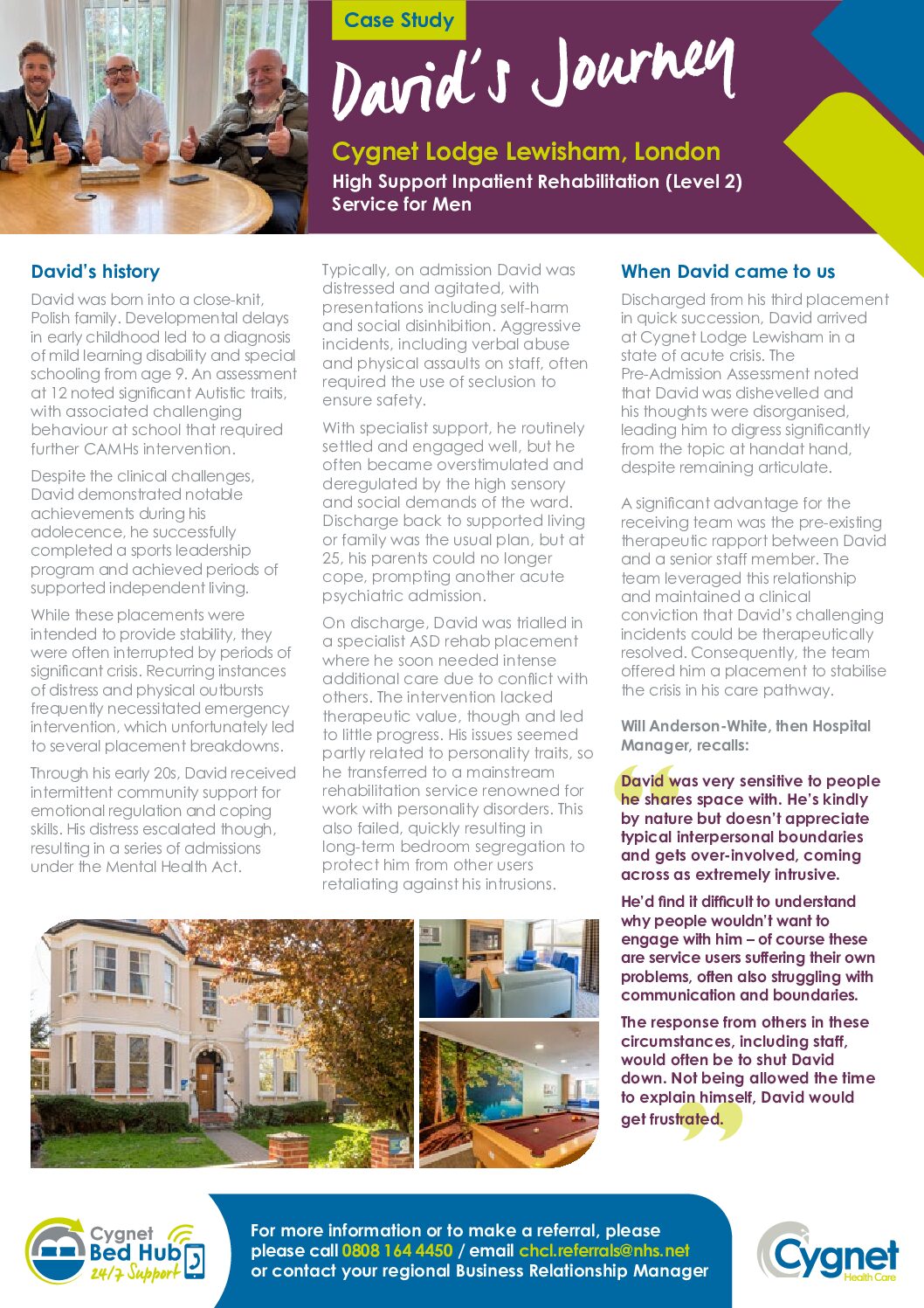
David and his father wanted to contribute to this case study and met with Will to review the experience of being placed at Cygnet Lodge Lewisham. His Dad praised the team’s culture of collaboration and early discharge focus. He said: “The culture of collaboration and the way the manager cultivated this and a focus very early in the admission on discharge planning was excellent”.
“At Lewisham Lodge they know how to talk to you. I trusted the staff there, and that wasn’t the case in my other hospitals. Will helped me and my parents get on better. I’m not an angel, but it’s a lot better now at home. Evenings are hard, as I get frustrated. But I’m hoping once I start work and have stuff to do in the day even that will be better. I’m hoping one day to get my own council place to live and get work as a carer. That’s something new. I’ve got hope for the future”.David